This is a pretty good list of websites:
The History of the Gold Standard: 25 Great Web Sites to Research Its Rise and Fall
The lecture is largely based on this article in particular By Lawrence H. Officer
Showing posts with label economic history. Show all posts
Showing posts with label economic history. Show all posts
Saturday, March 27, 2010


Thursday, March 25, 2010
Economist's View: Stop Panicking.
"Stop Panicking: Capitalism Repeatedly Recovers from Financial Crises"
Bill Easterly emails to ask what I think of this:
Stop panicking: Capitalism repeatedly recovers from financial crises, by William Easterly: I am just beginning to dive into the awesome book by Carmen Reinhart and Ken Rogoff, This Time is Different: Eight Centuries of Financial Folly. Along with great analysis, they have some wonderful pictures, evidence, and data. What I say here is my own take on it.
First, financial crises are remarkably common. Their Figure 5.1 shows the number of countries that have defaulted on their external debt (one possible dimension of a financial crisis) over the last two centuries. The numbers come in episodic waves of defaults and involve a remarkably high number of countries in each wave:

Second, the global capitalist system does well in the long run anyway. Average per capita income in the world (a shaky estimate, but probably right order of magnitude) increased by a multiple of 12 over 1800-2008, despite repeated epidemics of financial crises.
The US is arguably the country with democratic capitalism the longest, and it also shows a steady upward trend from 1870 to the present, despite repeated banking crises (using those identified by Reinhart and Rogoff), with usually little effect of each crisis on output relative to trend (except for the Great Depression).

Reinhart and Rogoff calculate directly the growth pattern before and after crises in advanced capitalist economies, and growth does indeed recover quickly to the trend growth rate of around 2 percent per capita per annum. 2 percent per capita is roughly the same growth rate that increased US per capita income so much from 1870 to the present.

y-axis reads "Real GDP Growth (Percent)"
I don’t mean to minimize the short run pain that the current financial crisis has caused. It’s horrible. But there is no reason to panic about the long run growth potential looking forward.
The obvious rejoinder is Keynes’ “in the long run, we are all dead.” But we can’t ignore that Capitalism already survived repeated financial crises and has made us all vastly better off despite them. So here’s a counter-quote: “In the long run, we are all better off because our dead ancestors stuck with capitalism.”
My take is a bit different. The graph of per capita income from 1870 - 2008 seems to say we shouldn't worry that aggressive intervention to stimulate the economy will cause long-run problems. It may help substantially in the short-run, but the graph above indicates it's unlikely to have long-run consequences. So, I agree, let's not panic. Let's not panic and start reducing stimulus measures too soon, or be too timid with stimulative policies, out of fear it might harm long-run growth. As the Great Depression shows us -- a time when there were legitimate fears about capitalism ending -- the more attention we pay to the short-run problems that undermine support for capitalism, the better chance there is that it will survive in the long-run.
I should acknowledge the Reinhart and Rogoff finding that debt levels higher than 90% of GDP are associated with lower economic growth:
...[D]ebt burdens are racing to thresholds of (roughly) 90 per cent of gross domestic product and above. That level has historically been associated with notably lower growth.
While the exact mechanism is not certain, we presume that at some point, interest rate premia react to unchecked deficits, forcing governments to tighten fiscal policy. Higher taxes have an especially deleterious effect on growth. ...
Given these risks of higher government debt, how quickly should governments exit from fiscal stimulus? This is not an easy task, especially given weak employment, which is again quite characteristic of the post-second world war financial crises... Given the likelihood of continued weak consumption growth in the US..., rapid withdrawal of stimulus could easily tilt the economy back into recession. Yet, the sooner politicians reconcile themselves to accepting adjustment, the lower the risks of truly paralysing debt problems down the road. ...
But as Rogoff notes elsewhere,
Monetary policy has done what it can to limit damage. Fiscal policy I would also give high marks to. We moved in the right direction in as timely a manner as possible.
I am not as willing to give fiscal policy high marks. We could have, and should have, done more to help the economy, and it certainly could have been more timely. As for fears more aggressive intervention will lower long-run growth, so long as we have the discipline to exit from these policies gracefully -- to pay the bill for the stimulus package in the good times -- long-run growth should not be affected by aggressive intervention in the short-run.
I believe that when the time comes to pay for the stimulus package, we'll do the right thing, just as we've always done in the past (yes, I know I'm being Pollyannish). And, in any case, the long-run debt problem has little to do with the stabilization measures used to counter the effects of the recession. The growth in health care costs is the problem in the long-run, nothing else matters much in comparison. If we fix the health cost escalation problem, a much more aggressive intervention to help the economy could have easily been absorbed into the budget without creating problems. And if we don't fix the health cost problem, the size of the stimulus package is of little consequence by comparison.
Finally, on the general "stop panicking" message, when people are hurting -- and they are -- we ought to panic. Legislators have given little indication that the understand the urgency of the employment problem we face. We need more panic, not less, about the employment situation.
Bill Easterly emails to ask what I think of this:
Stop panicking: Capitalism repeatedly recovers from financial crises, by William Easterly: I am just beginning to dive into the awesome book by Carmen Reinhart and Ken Rogoff, This Time is Different: Eight Centuries of Financial Folly. Along with great analysis, they have some wonderful pictures, evidence, and data. What I say here is my own take on it.
First, financial crises are remarkably common. Their Figure 5.1 shows the number of countries that have defaulted on their external debt (one possible dimension of a financial crisis) over the last two centuries. The numbers come in episodic waves of defaults and involve a remarkably high number of countries in each wave:

Second, the global capitalist system does well in the long run anyway. Average per capita income in the world (a shaky estimate, but probably right order of magnitude) increased by a multiple of 12 over 1800-2008, despite repeated epidemics of financial crises.
The US is arguably the country with democratic capitalism the longest, and it also shows a steady upward trend from 1870 to the present, despite repeated banking crises (using those identified by Reinhart and Rogoff), with usually little effect of each crisis on output relative to trend (except for the Great Depression).

Reinhart and Rogoff calculate directly the growth pattern before and after crises in advanced capitalist economies, and growth does indeed recover quickly to the trend growth rate of around 2 percent per capita per annum. 2 percent per capita is roughly the same growth rate that increased US per capita income so much from 1870 to the present.

y-axis reads "Real GDP Growth (Percent)"
I don’t mean to minimize the short run pain that the current financial crisis has caused. It’s horrible. But there is no reason to panic about the long run growth potential looking forward.
The obvious rejoinder is Keynes’ “in the long run, we are all dead.” But we can’t ignore that Capitalism already survived repeated financial crises and has made us all vastly better off despite them. So here’s a counter-quote: “In the long run, we are all better off because our dead ancestors stuck with capitalism.”
My take is a bit different. The graph of per capita income from 1870 - 2008 seems to say we shouldn't worry that aggressive intervention to stimulate the economy will cause long-run problems. It may help substantially in the short-run, but the graph above indicates it's unlikely to have long-run consequences. So, I agree, let's not panic. Let's not panic and start reducing stimulus measures too soon, or be too timid with stimulative policies, out of fear it might harm long-run growth. As the Great Depression shows us -- a time when there were legitimate fears about capitalism ending -- the more attention we pay to the short-run problems that undermine support for capitalism, the better chance there is that it will survive in the long-run.
I should acknowledge the Reinhart and Rogoff finding that debt levels higher than 90% of GDP are associated with lower economic growth:
...[D]ebt burdens are racing to thresholds of (roughly) 90 per cent of gross domestic product and above. That level has historically been associated with notably lower growth.
While the exact mechanism is not certain, we presume that at some point, interest rate premia react to unchecked deficits, forcing governments to tighten fiscal policy. Higher taxes have an especially deleterious effect on growth. ...
Given these risks of higher government debt, how quickly should governments exit from fiscal stimulus? This is not an easy task, especially given weak employment, which is again quite characteristic of the post-second world war financial crises... Given the likelihood of continued weak consumption growth in the US..., rapid withdrawal of stimulus could easily tilt the economy back into recession. Yet, the sooner politicians reconcile themselves to accepting adjustment, the lower the risks of truly paralysing debt problems down the road. ...
But as Rogoff notes elsewhere,
Monetary policy has done what it can to limit damage. Fiscal policy I would also give high marks to. We moved in the right direction in as timely a manner as possible.
I am not as willing to give fiscal policy high marks. We could have, and should have, done more to help the economy, and it certainly could have been more timely. As for fears more aggressive intervention will lower long-run growth, so long as we have the discipline to exit from these policies gracefully -- to pay the bill for the stimulus package in the good times -- long-run growth should not be affected by aggressive intervention in the short-run.
I believe that when the time comes to pay for the stimulus package, we'll do the right thing, just as we've always done in the past (yes, I know I'm being Pollyannish). And, in any case, the long-run debt problem has little to do with the stabilization measures used to counter the effects of the recession. The growth in health care costs is the problem in the long-run, nothing else matters much in comparison. If we fix the health cost escalation problem, a much more aggressive intervention to help the economy could have easily been absorbed into the budget without creating problems. And if we don't fix the health cost problem, the size of the stimulus package is of little consequence by comparison.
Finally, on the general "stop panicking" message, when people are hurting -- and they are -- we ought to panic. Legislators have given little indication that the understand the urgency of the employment problem we face. We need more panic, not less, about the employment situation.
Thursday, March 4, 2010
Two articles about the free market myth of Chile
I am posting these two articles because Niall Ferguson really got my goat with his narrative of the Chilean coup in his Ascent of Money. Roughly (though not too roughly) his story went like this: "Thousands of people were killed and tens of thousands were tortured but, hey, they replaced a marxist with disciples of Milton Friedman, the personification of American free market capitalism and everyone got awesome pensions."
Anyway, the Chilean earthquake has focused attention on Chile. Here are a couple of articles that refute Ferguson's story:
The Chicago boys and the Chilean earthquake
Did Milton Friedman's legacy save hundreds of thousands of lives?
By Andrew Leonard
Fantasies of the Chicago Boys
Paul Krugman
March 3, 2010, 8:07 am

Ah, Chile. Remember how, during the Social Security debate, Chile’s retirement system was held up as an ideal — except it turned out that it actually yielded very poor results for many people, and the Chileans themselves hated it? Now we have the usual suspects claiming that Chile’s relatively low death toll in the quake proves that — you guessed it — Milton Friedman was right. You see, the Chicago Boys made Chile rich, and that’s what did it.
As a number of people have pointed out, there’s this little matter of building codes. Friedman wasn’t exactly fond of such codes — see this interview in which he calls such codes a form of government spending, because they “impose costs that you might not privately want to engage in”.
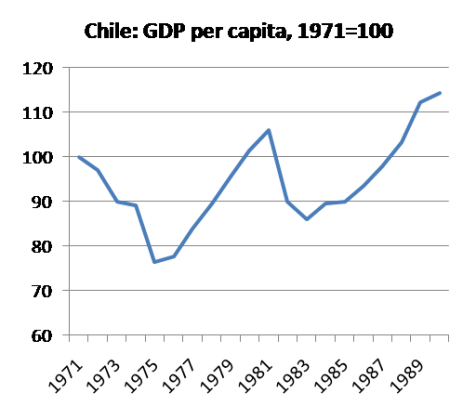
But there’s another point: the economics of Chile under Pinochet are a lot more ambiguous than legend has it. The way the story is told now, the free-market guys moved in, liberalized, and then there was a boom.
Actually, as you can see from the chart above, what happened was this: Chile had a huge economic crisis in the early 70s, which was, yes, partly due to Allende and the accompanying turmoil. Then the country experienced a recovery driven in large part by massive capital inflows, which mostly consisted of making up the lost ground. Then there was a huge crisis again in the early 1980s — part of the broader Latin debt crisis, but Chile was hit much worse than other major players. It wasn’t until the late 1980s, by which time the hard-line free-market policies had been considerably softened, that Chile finally moved definitively ahead of where it had been in the early 70s.
So: free-market policies are applied, and presto! prosperity follows — fifteen years later.
But remember, Obamanomics has definitely failed after 13 months.
Anyway, the Chilean earthquake has focused attention on Chile. Here are a couple of articles that refute Ferguson's story:
The Chicago boys and the Chilean earthquake
Did Milton Friedman's legacy save hundreds of thousands of lives?
By Andrew Leonard
The ghost of Milton Friedman, writes Bret Stephens in the Wall Street Journal, "was surely hovering protectively over Chile in the early morning hours of Saturday."
Thanks largely to him, the country has endured a tragedy that elsewhere would have been an apocalypse.
Stephens' logic is simple. After the U.S.-backed coup in 1973, in which Gen. Pinochet seized power from the democratically elected president Salvador Allende, a group of Chilean economists mentored by Friedman, and known to history as "the Chicago boys," instituted a series of radical free market reforms. Since that point, averaged over the decades, Chile has experienced the strongest sustained economic growth in South America. Rich countries, argues Stephens, are more likely to institute and enforce building codes. Q.E.D. Milton Friedman saved lives.
Some might find it intellectually provocative to cite Milton Friedman's authority in an argument that depends on the foundation of successfully enforced government-mandated building code regulations. The building inspector is not exactly a libertarian hero. Others might wonder if a more important factor in Chile's relatively tough building codes might be the devastating 9.5 earthquake the country endured in 1960. Haiti hadn't experienced an earthquake as bad as the one this January in 240 years. Earthquake resistant building codes tend to be taken more seriously in regions that are accustomed to regular bouts of annihilation.
But the earthquake is just a side show for the opinion page of the Wall Street Journal -- just another opportunity, however shameless, to push free market fundamentalism. One of the great blemishes on Milton Friedman's legacy is his association with the Pinochet government, which has been held responsible for murdering some 2, 000 to 3,000 people during its 17-year tenure, along with arresting tens of thousands of other citizens and enforcing harsh controls on the press and other civil liberties. Friedman's acolytes have long tried to wish away the complicity of the Chicago boys and their guiding light in one of the darkest chapters of modern Chilean history, but the stain is tough to get out. If trampling all over the democratically expressed wishes of the people and instituting an authoritarian reign of terror are what it takes to achieve economic growth, is it really worth it?
But a more pertinent question might be to ask just how much credit really is due Chicago-school economics for Chile's current relative prosperity? Mining alone accounts for 20 percent of Chile's GDP, and it is very much worth noting that the country's crown jewel, the copper industry, is completely dominated by one state-owned company, Codelco. Ponder that, for a second: Latin America's poster child for Chicago school economics features state control of the single most important economic resource. Huh.
Chile also suffers from some of worst income inequality in the world, and in fact, only began to take serious steps to address income disparities after the plebiscite that ended Pinochet's rule. And how did the government do that? By raising taxes and social spending.
But it's a job that's hardly finished, as evidenced by the reports of serious social disorder currently emanating from Chile, which some observers have compared unfavorably with Haiti.
Vast extremes in income equality do not make people happy, especially in the aftermath of huge disasters. That might be the true lesson of Chile, and it's one that the Chicago boys who make their home in the United States might do well to mull over.
Fantasies of the Chicago Boys
Paul Krugman
March 3, 2010, 8:07 am
Ah, Chile. Remember how, during the Social Security debate, Chile’s retirement system was held up as an ideal — except it turned out that it actually yielded very poor results for many people, and the Chileans themselves hated it? Now we have the usual suspects claiming that Chile’s relatively low death toll in the quake proves that — you guessed it — Milton Friedman was right. You see, the Chicago Boys made Chile rich, and that’s what did it.
As a number of people have pointed out, there’s this little matter of building codes. Friedman wasn’t exactly fond of such codes — see this interview in which he calls such codes a form of government spending, because they “impose costs that you might not privately want to engage in”.
But there’s another point: the economics of Chile under Pinochet are a lot more ambiguous than legend has it. The way the story is told now, the free-market guys moved in, liberalized, and then there was a boom.
Actually, as you can see from the chart above, what happened was this: Chile had a huge economic crisis in the early 70s, which was, yes, partly due to Allende and the accompanying turmoil. Then the country experienced a recovery driven in large part by massive capital inflows, which mostly consisted of making up the lost ground. Then there was a huge crisis again in the early 1980s — part of the broader Latin debt crisis, but Chile was hit much worse than other major players. It wasn’t until the late 1980s, by which time the hard-line free-market policies had been considerably softened, that Chile finally moved definitively ahead of where it had been in the early 70s.
So: free-market policies are applied, and presto! prosperity follows — fifteen years later.
But remember, Obamanomics has definitely failed after 13 months.
Sunday, August 30, 2009
Brad DeLong: Herbert Hoover: The working man's hero - How
Herbert Hoover: A Working Class Hero Is Something to Be
08/29/09
08/29/09
Oh Noes! Andrew Leonard reads Lee Ohanian:
Herbert Hoover: The working man's hero - How the World Works - Salon.com: I did not need a cup of coffee to wake up this morning -- I just checked my e-mail, and saw the subject header: "Hoover's pro-labor stance helped cause Great Depression, UCLA economist says."
Without reading the message, I knew instantly who the economist must be -- Lee Ohanian.... Last we saw of Ohanian... he was arguing that FDR's New Deal policies extended the Great Depression and resulted in "less work than average" for American workers. Which might be true, if you don't count anyone who got a job through "the Works Progress Administration (WPA) or Civilian Conservation Corps (CCC), or any other of Roosevelt's popular New Deal workfare programs." Makes sense -- if you don't count Roosevelt's pro-labor programs, he doesn't end up very pro-labor!
So now we have "What -- or Who -- Started the Great Depression?," a 68-page paper Ohanian has been working on for four years that is sure to become a never-to-be-extinguished talking point for New Deal haters, union-busters, and opponents of all kinds of government intervention in the economy. Here are some key points, taken from the press release pushed out by UCLA.
Pro-labor policies pushed by President Herbert Hoover after the stock market crash of 1929 accounted for close to two-thirds of the drop in the nation's gross domestic product over the two years that followed, causing what might otherwise have been a bad recession to slip into the Great Depression, a UCLA economist concludes in a new study. "These findings suggest that the recession was three times worse -- at a minimum -- than it would otherwise have been, because of Hoover," said Lee E. Ohanian, a UCLA professor of economics.
According to Ohanian, these pro-labor policies including pressure for job-sharing and propping up wages handcuffed industry's ability to respond flexibly to the post-crash economic contraction.
After the crash, Hoover met with major leaders of industry and cut a deal with them to either maintain or raise wages and institute job-sharing to keep workers employed, at least to some degree, Ohanian found. In response, General Motors, Ford, U.S. Steel, Dupont, International Harvester and many other large firms fell in line, even publicly underscoring their compliance with Hoover's program. "By keeping industrial wages too high, Hoover sharply depressed employment beyond where it otherwise would have been, and that act drove down the overall gross national product," Ohanian said. "His policy was the single most important event in precipitating the Great Depression."
Hoover as the pro-labor liberal! Never mind that Hoover spent decades after his spectacularly failed presidency bemoaning the country's New Deal turn to Bolshevism. And never mind that the definitive conservative economic treatment of the Great Depression, Milton Friedman and Anna J. Schwartz's "A Monetary History of the United States," pinpoints monetary policy mistakes by the Federal Reserve as the crucial catalyst that turned a stock market crash and recession into a Depression. Never mind the now-fading cultural memory of the United States, which somehow remembers Hoover as being bad for labor, and Roosevelt being good. All that pales against the necessity of making a key political point relevant to today's financial crisis.
There is a germ of information buried in the pile: Hoover did urge business leaders to be gentle to their workers because, he assured them, the Great Depression would soon be over.
But Hoover's interventions do not appear to have had much effect. If you take the degree of government-sponsored union power and wage rigidity in post-WWII Europe to be 100, then FDR's New Deal counts as a 30 and Herbert Hoover's "can't we all just get along?" White House meetings count as a five. If Hoover's inviting businessmen to the White House could push the unemployment rate up from 4% to 23%, simple extrapolation would then suggest that Roosevelt's labor-market policies ought to have pushed unemployment up to 118%--and unemployment in post-WWII Europe ought to have averaged 384%.
It simply does not appear as if Hoover's exhortations had much effects. Average wages in manufactuing stood at $0.55 in 1930, at $0.51 in 1931--an 8% cut--and $0.44 in 1932--a 20% cut. Coal miners' hourly wages went from $0.66 in 1930 to $0.63 in 1931 to $0.50 in 1932--a 25% cut. Skilled male manufacturing workers' wages went from $0.66 an hour in 1930 to $0.63 in 1931 and $0.56 in 1932. You had the same 20% cut in nominal wages over 1930-1932 as you had over 1920-22 (but a 50% decline in industrial production in total in the 1930s and only a 30% decline in industrial production in the 1920s). The argument would have to be that if not for Hoover, firms would have cut wages much, much faster than they in fact did.
In 1996 Ben Bernanke and Kevin Carey, in their "Nominal Wage Stickiness and Aggregate Supply in the Great Depression," plotted real wages and industrial production levels in 1932 relative to 1929 for 22 countries:

Four countries--Australia, Argentina, Hungary, and New Zealand--have low relative real wage levels in 1929 not because employers have cut wages but because they are small open economies and had already undergone massive currency develuation by 1932: wages were more or less where they were in 1929 but the domestic price level was much higher because the currency was worth less. the rest of the countries were still on or not yet far off the gold standard. Some--Germany and the U.S.--had relatively low real wages and were doing horribly. Some--Norway and Japan--had relatively low real wages and were doing well. And some--Belgium, France, the Netherlands, the United Kingdom, and Switzerland--had relatively high real wages and were doing middling. The scatterplot strongly suggest that Hoover's interventions (a) were too feeble to make the U.S. a more-than-average country in the downward rigidity of its nominal wages, and (b) that at least as of the end of Hoover's term, how deep the Great Depression was in your country had very little to do with whether your internal nominal wages level had fallen far or not.
As Eric Rauchway points out, to blame the Great Contraction of 1929-1932 on government interference in the labor market creates a very strong presumption that thereafter the Great Depression should have gotten much worse rather than eased--for the interferences in the 1930s, starting with the NIRA, were much larger deviations from laissez-faire:
[H]ere's the thing: if you want to say, "I'll take 'Causes of the Great Depression', Alex," you have to be prepared with an explanation for (a) why things got so bad under Hoover and (b) why they then got better under Roosevelt.
Monetarist models explain this: the gold standard was deflationary, and going off the gold standard helped countries out of the Great Depression. Hoover didn't go off the gold standard. FDR did. Things got better.
Keynesian models explain this: Hoover didn't do enough to stimulate demand. Roosevelt did more (though still not quite enough).
Ohanian's model doesn't explain this.
And I would like to raise a further caution. Ohanian is working in a framework in which nominal demand--the total dollar flow of spending--is constant. In such a framework lower wages lead businesses to cut their prices and so the same flow of demand buys more goods, and that induces firms to hire more people and produce more. Jacob Viner, Milton Friedman's teacher, strongly cautioned against this line of argument in 1933 because a decline in wages was part of an "unbalanced deflation." Wages fell, but debt principal and interest paymenst did not.
In Viner's view, and in mine, if wages had fallen faster and further, goods prices and real estate prices would have fallen further and faster, more banks would have gone into bankruptcy, the bank failures would have shrunk the money supply even more, the velocity of money would have fallen even further, and the Great Depression would have been even worse.
Larry Summers and I wrote a paper about this back in the 1980s.
Milton Friedman's teacher Jacob Viner always argued that it was "unbalanced deflation" -- i.e., declines in asset prices and wages and incomes while debts remained the same -- that was the cause of the Great Depression. So did monetarist school founder Irving Fisher.
Ask yourself: if everybody's salary in America were to be cut right now by 25 percent -- but everyone's mortgage payment, everyone's credit card balance and interest payment, and every corporation's debt interest payments remained the same--would we see a recovery or another chain of financial bankruptcies that would push the economy down further?
Subscribe to:
Posts (Atom)